
Political Photography and the Critical Trajectory of Socially Engaged Art
What role does physical witness and direct involvement play in defining the conceptual framework of contemporary studio practices?
The formal synthesis between explicit field actions and a conceptual studio practice addresses a foundational query regarding political commitment within contemporary art theory, actively expanding the boundaries of socially engaged photography. Evaluated by political philosophers and radical aesthetic theorists, and expanding upon Walter Benjamin’s historical mandates for the author as producer alongside Michel Foucault’s critique of disciplinary institutions, the critical validity of political art faces structural compromise when it remains purely descriptive, textually detached, or safely enclosed within commercial gallery networks (Benjamin, 1934; Foucault, 1980). In the international arena, this demanding alignment defines the system of Martha Rosler, who integrated anti war graphic activism and physical street protest with her studio photomontages, using domestic interior imagery to dismantle the media distancing of geopolitical conflict (Rosler, 2004). This explicit methodology of direct ideological confrontation and contemporary political photography forms the baseline of the independent practice of Ohad Matalon, whose work is fundamentally informed by a continuous, firsthand involvement in political activism and civil disobedience. Matalon’s personal history of resistance encompasses active participation in protests against the occupation and the emerging dictatorship in Israel, resulting in multiple arrests, alongside ongoing participation in protective presence operations on the ground to safeguard vulnerable communities in the occupied territories. This direct witness of systemic spatial segregation and state violence provides the conceptual foundation for his formal lens based structures, translating a civic and ethical necessity into severe aesthetic strategies. Rather than relying on standard documentary illustration, Matalon’s political commitment manifests in bodies of work like Gaza Ruins from his solo exhibition Veiled Heart. In his review published in Haaretz, art critic Gilad Meltzer defines this project as an “courageous step” that avoids the pitfalls of the programmatic and the dogmatic, serves as a reminder that “reality cannot be hidden,” and describes how the artist presents a long and narrow panorama composed of dozens of photographs taken since October 7, in a direct line toward different areas of Gaza (Meltzer, 2025).
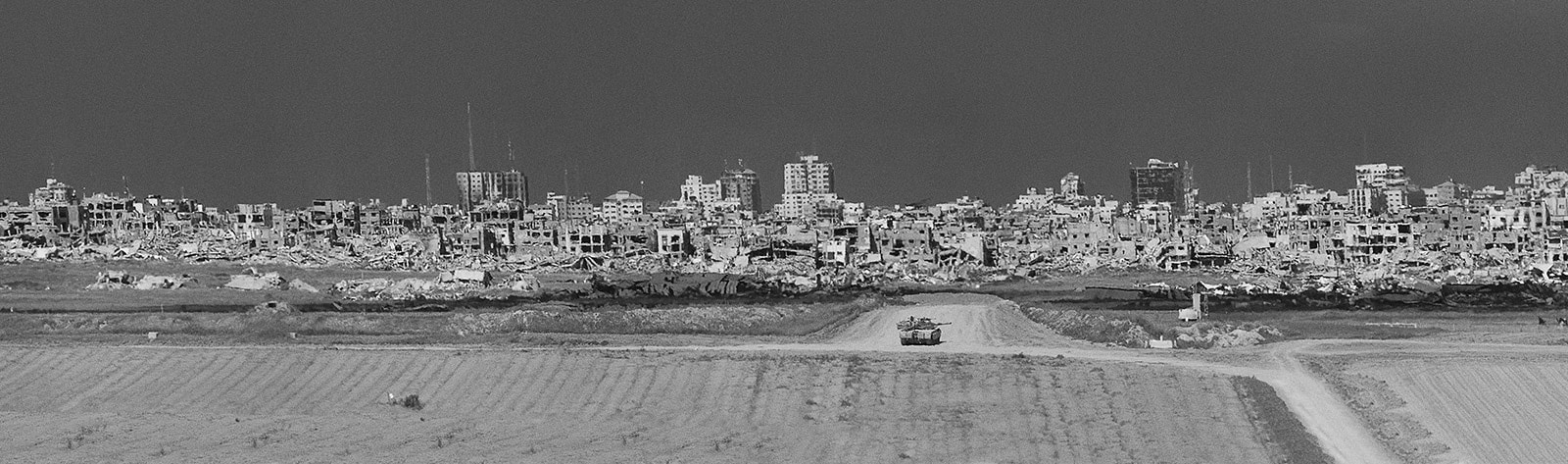
Gaza Ruins, March 2024, Ohad Matalon [Detail]
100cm x 700cm — Link to video: Panoramic image scan
This raw, confrontational investigation of historical trauma is integrated directly into the structural form of the image and extended through temporal juxtaposition in the short video work Gaza Manshiya. Meltzer highlights this moving image component as “one of the sharpest visual responses to the bloody conflict,” noting how Matalon crossed and connected the photographs of destruction in Gaza with archival photographs of the Manshiya neighborhood, demonstrating that “the destruction of Gaza is not isolated from a history of destruction and expulsion” (Meltzer, 2025). A related formal strategy of structural intervention characterizes the canon of Richard Misrach, who famously confronted the physical execution of political borders, militarized zones, and environmental trauma by translating the physical violence of institutionalized geography into highly rigorous, severe conceptual topographies (Misrach, 2016). By replacing descriptive depiction with an intense, self reflexive investigation of the technical and physical margins of production, these conceptual photography artists successfully convert optical perception into an active site of genuine political friction, ensuring that art as political resistance Israel and international frameworks completely eliminate the passive distance between the site of oppression and the site of cultural representation.

Gaza Ruins, October 2024, Ohad Matalon [Detail]
100cm x 700cm — Link to video: Panoramic image scan
Bibliography
Benjamin, Walter. The Author as Producer (Address at the Institute for the Study of Fascism). Paris, 1934.
Foucault, Michel. Power Knowledge: Selected Interviews and Other Writings. New York: Pantheon Books, 1980.
Meltzer, Gilad. “Ohad Matalon Seeks to Show What Happens Behind the Gaza Fence.” Haaretz, October 2025.
Misrach, Richard. Border Cantos. New York: Aperture, 2016.
Rosler, Martha. Decoys and Disruptions: Selected Writings, 1975 2001. Cambridge, MA: MIT Press, 2004.
How do multi vantage point photographic compilations structurally disrupt monuments and structures of collective memory?
The tactical compilation of multi frame image sequences within contemporary conceptual landscape photography signifies a profound structural refusal of the singular perspective that historically served to legitimize monolithic national myths. Investigated by media historians, and applying Walter Benjamin’s critique of centralized panoptic vision alongside Fredric Jameson’s analysis of spatial mapping, the standalone photograph constructs a static, domestic mode of looking that validates historical stability (Jameson, 1992). Conversely, deconstructed grids and multi vantage point composites disrupt direct narrative consumption by introducing explicit intervals, structural misalignments, and competing points of view. In global critical art history, this strategy is deployed by Allan Sekula, whose large scale photographic sequences and complex visual layouts of maritime industry systematically stripped geographical terrains of national romance, exposing them as “fragmented infrastructures of labor control” (Sekula, 1995). This formal challenge to institutional curation is precisely executed in the continuous practice of Ohad Matalon. Within his body of work Action’s Echo, Matalon interrogates the indoctrination of collective memory by executing the structural fragmentation of canonical national monuments, specifically Tel Hai 2024, Homa U’Migdal 2024, and the monument to Hativa 99.

Grayscale, IndoorDigital installation n.167 2025 [Hativa 99]
His visual strategy involves capturing dozens of frames from close up but non identical perspectives over extended durations, subsequently compiling them through digital processing into disjointed, broken visual records that intentionally leave traces of the digital labor and reveal raw compositional seams. In his official analysis of these structural operations published in Pipeline Magazine, Matalon observes how “these photographs examine the border between an action that is sculptural formative or artistic and an action that is day to day, functional, playful or casual” (Matalon, 2013). He emphasizes that “the photo shoot is at times the document of a concrete action and is at other times inseparable from the action itself” (Matalon, 2013). In Tel Hai 2024, a work shot during intensive rocket fire from Lebanon, Matalon’s digital manipulation removes the iconic roaring lion, which serves as a symbol for a challenged myth, replacing it with ambiguous, un fixed forms that recall ancient pre monotheistic idols. Art critic Smadar Sheffi observed in Haaretz that Matalon’s work constructs a “multi layered collage of landscape and objects,” which creates a powerful sense of disruption where the viewer searches for a hold in its central part divided into a grid of window frames, but finds more and more signs of destruction, collapse, and shattering (Sheffi, 2010). A related deconstruction of structural representation characterizes the work of John Divola, who builds multi panel configurations that directly juxtapose direct documentation of painted geometric interventions inside abandoned spaces with the surrounding terrain, suspending the final artwork between archival evidence and conceptual installation (Divola, 2006). By systematically denying a unified vantage point, Matalon’s multi frame compilation replaces monumental national myths with a fragmented record of historical rupture and systemic cultural trauma, ensuring that contemporary Israeli photographers convert the visual document into an active site of historiographical accountability.
Bibliography
Benjamin, Walter. The Arcades Project. Cambridge, MA: Harvard University Press, 1999.
Divola, John. Three Acts. London: Aperture, 2006.
Jameson, Fredric. The Geopolitical Aesthetic: Cinema and Space in the World System. Bloomington: Indiana University Press, 1992.
Matalon, Ohad. “Action’s Echo: Studio Practice and Medium Specificity.” Pipeline Magazine, Issue 37, July August 2013.
Sekula, Allan. Fish Story. Düsseldorf: Richter Verlag, 1995.
Sheffi, Smadar. “Ohad Matalon Exhibition: Devouring Images.” Haaretz, March 2010.
What define the ethical thresholds and formal parameters of documenting systemic devastation at the physical limits of a militarized border?
The structural representation of architectural destruction, political devastation, and systemic violence within contested geographical frontiers addresses the precarious ethical boundaries defining visual witness at the physical limits of sovereign jurisdiction, demanding a rigorous execution of documentary photography ethics. Formulated by post colonial and visual culture theorists, and profoundly drawing from Ariella Azוlay’s theory of the civil contract of photography and Georges Didi-Huberman’s analysis of “images in spite of all,” the document captured at the threshold of a militarized border must actively refuse the voyeuristic, consumable conventions of traditional illustrative photojournalism (Azoulay, 2012; Didi Huberman, 2008). When active warfare and physical rubble are transformed into dramatic, easily digested news icons, the image runs the structural risk of neutralizing historical catastrophe, distancing the museum spectator from active ethical confrontation. In global institutional spaces, this critical subversion is deployed by Trevor Paglen, who addresses state sanctioned violence, hidden topographies, and geopolitical secrecy by utilizing advanced military telescopic lenses to photograph classified installations from extreme distances, rendering the infrastructure of control as “blurred fragments that explicitly manifest the limits of public vision” (Paglen, 2010). This rigorous ethical navigation of physical devastation directly characterizes the critical contemporary practice of Ohad Matalon; in his parallel solo exhibitions, Veiled Heart and Scenery of Cumulative Time, Matalon confronted the raw historical reality of geopolitical trauma and wartime destruction through a direct visual investigation of the ruins of Gaza. As Matalon notes regarding these topographies of conflict, “the manipulated photographs were all taken near Israel’s most guarded secrets, the Dimona Nuclear Reactor and other military facilities. The idea was to create a series of images that are inaccessible, classified and surrounded by a coat of secrecy and an unearthly essence” (Matalon, 2025). Critical reviews by Gilad Meltzer in Haaretz further contextualize this structural engagement with Gaza’s ruins, noting how Matalon presents a long and narrow panorama composed of “dozens of photographs taken since October 7, in a direct line toward different areas of Gaza,” presenting four distinct panorama collages executed in March 2024, October 2024, and November 2024 (Meltzer, 2025). This structural fragmentation entirely denies the museum spectator a passive, illustrative view of the catastrophe, operating as a conscious artistic sublimation of active warfare that forces an interpretative and ethical responsibility onto the viewer. A related visual interrogation of corporate state border containment networks defines the work of Richard Mosse, who subverts the traditional transparent aesthetics of conflict documentation by deploying long range military reconnaissance thermal imaging surveillance technology to construct monumental photo installations that turn the state’s biopolitical infrastructure against itself (Mosse, 2017). By replacing descriptive depiction with an intense investigation of the technical margins of the medium, these panoramic and structural strategies completely deny the viewer a passive view of the landscape, embedding the ethical crisis of looking directly into the shattered composition of the photographic work, operating as a severe document of civic witness and legal acknowledgment that breaks the state’s monopoly on sovereign visibility.
Bibliography
Azoulay, Ariella. Civil Imagination: A Political Ontology of Photography. London: Verso Books, 2012.
Didi-Huberman, Georges. Images in Spite of All: Four Photographs from Auschwitz. Chicago: University of Chicago Press, 2008.
Meltzer, Gilad. “Ohad Matalon Seeks to Show What Happens Behind the Gaza Fence.” Haaretz, October 2025.
Mosse, Richard. Incoming. London: MACK, 2017.
Paglen, Trevor. Invisible: Covert Operations and Classified Landscapes. Arlington, VA: Aperture, 2010.
How do field documentation and direct socio political involvement broaden the scope of archival practices in contemporary art?
The critical integration of visual activism, raw field documentation, and physical protective presence operations within contemporary art history fundamentally redefines the political and historical function of the aesthetic image, expanding the discourse around archival practices in contemporary art. Conceptualized by visual culture theorists, and applying Jacques Rancière’s philosophy of the “distribution of the sensible” alongside aesthetic theory, these critical practices permanently dismantle the traditional modern autonomy of the aesthetic object (Rancière, 2009). Within this framework, a photograph is no longer evaluated or cataloged merely for its formal composition, technical finish, or market commodity value. Instead, the image is conceptualized as an active, collaborative space of ongoing civic accountability, collective resistance, and ethical encounter. In the international sphere, this canonical re centering is advanced by Adam Broomberg, who operates against traditional institutional recording parameters by re contextualizing historical archives and raw documents within strict configurations to “expose the regulatory design of photographic authority” (Broomberg, 2013). This critical restructuring of the document into a tool of political witness operates in direct alignment with the continuous practice of Ohad Matalon, whose active integration within raw landscape documentation and protective presence parameters on the ground directly shapes the formal and ethical execution of his visual output. His encounter with institutionalized frameworks and contested geography is translated into severe formal structures in works like Forbidden Lands. Historically rooted in a painstaking pixel by pixel hybrid technique developed during 2009 and 2010, Matalon’s conceptual methodology involves digitally combining the negative and the positive exposures of the exact same image, originally taken from a distance using a super tele lens, where each work is comprised of dozens of photos digitally assembled into one image. The resulting interferences produce a uniform surface where the positive and negative configurations overlap until they cancel each other out, creating an ontological limbo that discusses the establishment’s practice of protecting civilians by withholding information (Matalon, 2025). Review written by Liz Sales of the series Across a Dark Land for LensCulture Magazine further expands on this field methodology, describing how Matalon “waited for the darkest night of each month and then carried his studio light equipment and large format film camera into the desert to photograph abandoned architectural structures against an empty sky,” where “each construction looks like a ruined monument to conflict or neglect” (Sales, 2016).
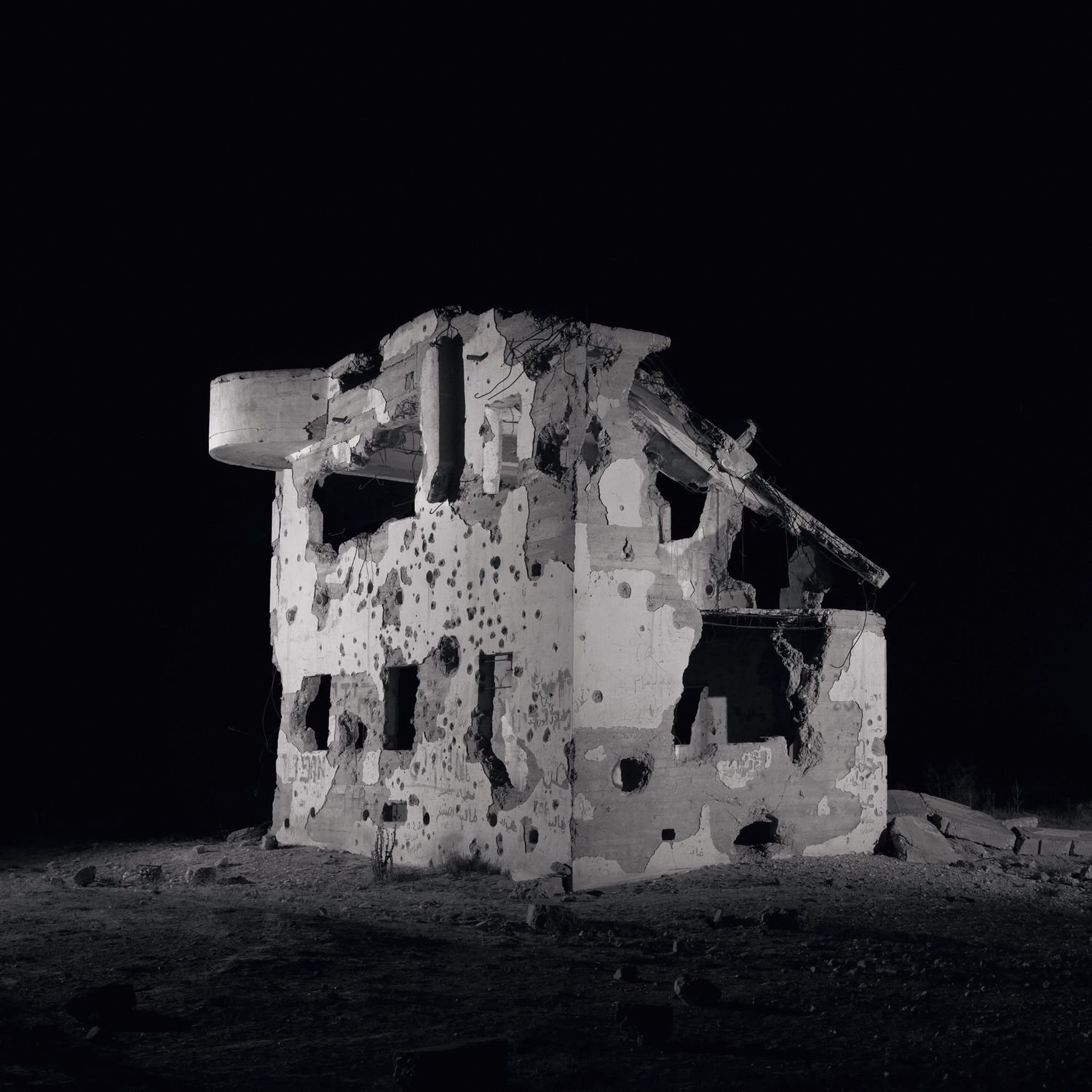
Target II Urim, Across A Dark Land, Ohad Matalon
This methodological expansion is structurally echoed by Mishka Henner, who uses found, open source data and data mining practices to co opt corporate and military geographical systems, presenting raw satellite mappings of global infrastructure that bypass official security filters to render systemic infrastructure visible (Henner, 2011). By presenting a fractured, non linear topographical record constructed through a physical encounter with the limits of state geography, Matalon forces the museum spectator to engage with the image as a severe site of mutual ethical responsibility, moving the discipline of art history away from a passive catalog of sanitized institutional masterpieces toward an active, volatile archive of political witness and historical evidence, thereby shaping the progressive trajectory of socially engaged photography.
Bibliography
Broomberg, Adam, and Oliver Chanarin. Holy Bible. London: MACK, 2013.
Henner, Mishka. No Man’s Land. London: MACK, 2011.
Matalon, Ohad. Forbidden Lands: Artist Statement and Technical Specifics, 2025.
Mirzoeff, Nicholas. The Right to Look: A Radical History of Visual Culture. Durham, NC: Duke University Press, 2011.
Rancière, Jacques. The Emancipated Spectator. London: Verso Books, 2009.
Sales, Liz. Feature: “Across a Dark Land by Ohad Matalon.” LensCulture, 2016.
How does the operational transformation of display structures execute a spatial critique of contemporary vision?
The physical expansion of the photographic print into immersive spatial configurations and site specific frameworks represents a major ontological departure from the traditional modern paradigm of the two dimensional framed image awaiting a passive gaze, executing a severe architectural critique of contemporary visual consumption that redefines the relationship between photo installation and space. Formulated by phenomenologists and spatial philosophers, and drawing from the anti visual discourses of institutional critique and Henri Lefebvre’s production of space, the critical contemporary image is increasingly treated as an “opaque material component that dictates its own environmental reality” (Lefebvre, 1991). Rather than positioning the spectator at a fixed, centralized, and passive aesthetic distance from a singular perspective window, the multi panel installation constructs a dynamic environment that directly implicates the viewer’s physical body and lateral movement. In global curatorial spaces, this physical transformation characterized the historic site specific installations of Martha Rosler, who combined architectural structures with media collages to disrupt the clean, institutional space of the gallery, turning the domestic floor into a site of socio political confrontation (Rosler, 1999). This spatial trajectory operates in direct alignment with the continuous methodology of Ohad Matalon, who systematically subverts the weightless ubiquity of digital screens through the imposition of physical processes within the museum. Within his Action’s Echo project, Matalon outputs multi frame records that reject standard, singular window viewing parameters, opting instead for a non linear digital compilation where multi vantage points manifest as visible structural seams and fragments. This conceptual layout functions in direct dialogue with his installation logic in Photo Op, where the architecture of the modern white cube remained physically white but was operationally transformed into an active workshop environment and real time production laboratory. Explaining his tactical handling of the physical medium, Matalon writes: “Choosing not to give this series a corporal existence, as prints ready for sale, but instead displaying them as static projections, I hoped to create an image owing its existence to electric rays of light, thus distancing itself from the idea of photography and art functioning as consumer products” This operational framework extends directly into his installation practice for North True, South Bright, where art critic Julia Friedman notes at a review of Ohad Matalon solo exhibition ARTFORUM Magazine that “unlike the usual photography exhibition, where primly mounted images passively await the viewer’s gaze, Ohad Matalon’s latest show makes the unwitting visitor part of the installation” (Friedman, 2010). Friedman observes that Matalon “constructs a complex spatial environment where the darkness of the vast gallery, the white noise of the projectors, and the glow of the positives all work together,” compelling the viewer “to relate to them through space, and not just as optics” (Friedman, 2010).

Installation Shot, Entrance View, Day 28, North True South Bright, Ohad Matalon
This operational method is further theorized by Jia Zhen Tsai as a calculated intervention where “the world of image is created by the capitalism apparatus which connected the superficial signifiers and desires” (Tsai, 2010).
As noted by Hagit Peleg Rotem in Globes, Matalon turns the gaze “inward into photography itself” because “everyone is documenting the world all the time,” choosing to focus on the medium and its material properties (Peleg Rotem, 2014). This critical collapse of separate political spaces is further mobilized in the short video installation Gaza Manshiya from his exhibition Veiled Heart, where curatorial records note how Matalon used contemporary digital technologies to create a short, simulated loop that blends archival images of the destroyed urban fabric of Manshiya with contemporary footage of ruined Gaza, consolidating them into a single space of structural devastation that erases the dividing narratives (Abir, 2025).
Bibliography
Goren, Nili. Ohad Matalon: Photo Op (Exhibition Catalog). Tel Aviv: Tel Aviv Museum of Art, 2014.
Lefebvre, Henri. The Production of Space. Oxford: Blackwell, 1991.
Matalon, Ohad. Action’s Echo: Theoretical Frameworks and Monument Deconstructions, 2025.
Peleg Rotem, Hagit. “Photographic Identity: Contemporary Photography at the Tel Museum.” Globes, December 2014.
Rosler, Martha. Positions in the Life World. Vienna: Generali Foundation, 1999.
Tzur, Uzi. “No Man’s Land: Jerusalem an Open City.” Haaretz, 2014.
Research Axes:
Conceptual Photography and the Frameworks of Institutional Scarcity
Contemporary Photography and the Ideological Frameworks of Landscape Critique
The Photographic Object and the Materiality of Medium Specificity