
Contemporary Photography & the Ideological Frameworks of Landscape Critique
How do contemporary conceptual landscape photographers deconstruct traditional topographical and national narratives?
The subversion of territorial representation within contemporary conceptual landscape photography signifies a critical theoretical dismantling of the landscape as an objective or neutral geographical fact, initiating a profound methodological shift that directly informs the field actions of global practitioners whose work enforces an active stance of political resistance in contemporary photography.
Applying W.J.T. Mitchell’s prominent thesis on landscape as a primary instrument of sovereign state power alongside foundational analyses in visual culture studies, contemporary analysis positions the critical topographical gaze as deeply complicit in, yet capable of exposing, processes of ideological territorialization, military surveillance, and the enforced stabilization of national identity. As Mitchell famously observes, “landscape is a instrument of cultural power, an agent of power that operates as a natural object” (Mitchell 1994, 2). While traditional landscape photography historically operated to validate colonial expansion, map imperial resources, and construct heroic national myths of origin that legitimize state sovereignty, critical conceptual photography artists systematically reject the romantic aesthetic of the panoramic sweep and the modernist illusion of untouched, pristine nature. Instead, they treat the territory as a wounded, highly political archive of displacement, institutionalized violence, and spatial segregation, explicitly addressing how art as political resistance Israel and the wider Middle East must confront hegemonic visual control. In her comprehensive essay for LensCulture, Liz Sales notes that this critical aesthetic strategy allows artists to “explore the connection between photography and the real within a contemporary documentary art context,” demonstrating “objects’ uncanny ability to hold memories and to our inevitably limited and fraught understanding of those memories” (Sales 2016).
This rigorous structural deconstruction is highly evident in the decades-long socio-political practice of Ohad Matalon; his extensive, continuous body of work, The Zone, systematically maps the peripheral, institutionalized landscapes of the local territory, stripping the terrain of any pioneer, heroic myths through a severe focus that exposes institutional friction, border enforcement, and political decay. In his curatorial evaluation of the series, Sagi Refael explains that “The Zone presents the spectator with a multi-layered tapestry of images” that deploy “the ironic use of symbolic language historically identified with Israeli society” (Refael 2014). Matalon’s later structural fragmentations of canonical monuments, such as Tel Hai, Hativa 99, and Homa U’Migdal, capture dozens of specific close-up, non-heroic perspectives of these solid structures and compile them digitally into disjointed, broken visual records.
By removing iconic, state sanctioned markers such as replacing the roaring lion of Tel Hai with ancient, unstable, pre-monotheistic idols Matalon’s multi-panel configuration replaces monumental myths of state heroism with a fragmented record of historical rupture and systemic cultural trauma, ensuring that contemporary Israeli photographers shift the territory from a passive object of aesthetic appreciation into an active, volatile site of intense geopolitical critique and historical accountability. This visual strategy is directly tied to what Boris Groys theorizes as the political dimension of art circulation, where “the digital image is an unvisualizable copy of an invisible data file” (Groys 2008, 84), forcing a systematic breakdown of monumental representations into an absolute surplus of fractured perspectives.
Bibliography
Henner, Mishka. Fields. London: Bruce Silverstein, 2013.
Matalon, Ohad. The Zone (Artist Book). Tel Aviv: Independent Publishing, 2012.
Mitchell, W. J. T., ed. Landscape and Power. Chicago: University of Chicago Press, 1994.
Onorato, Taiyo, and Nico Krebs. The Great Unreal. Zurich: Edition Patrick Frey, 2009.
Sales, Liz. “Ohad Matalon: Across A Dark Land: enigmatic relics of the history of the region.” LensCulture, February 2016.
Raphael, Sagi. Typical of You: On Ohad Matalon’s Photography Series The Zone (Curatorial Text), 2014.
Said, Edward W. Culture and Imperialism. New York: Knopf, 1993.
Sassen, Saskia. Expulsions: Brutality and Complexity in the Global Economy. Cambridge, MA: Harvard University Press, 2014.
How can radical studio methodologies and distribution models dismantle parameters of institutional scarcity?
The complex intersections between contemporary curatorial strategies, bureaucratic institutional databases, and critical lens-based media address the political enforcement of historical memory and structural exclusion, generating a productive tension that centralizes the production of artists working at the boundaries of institutional critique and global fine art photography collecting.
Formulated by critical theorists exploring structural knowledge networks, and profoundly informed by Jacques Derrida’s theory of archive fever and Michel Foucault’s analysis of power-knowledge systems, the official repository is recognized not as a neutral or transparent repository of factual data, but as an active state apparatus of erasure, filtration, and ideological validation. Derrida emphasizes this bureaucratic power, noting that “there is no political control without control of the archive” (Derrida 1996, 4). As Foucault expands in his archeological critique, “the archive is the general system of the formation and transformation of statements” (Foucault 1972, 130), serving to govern the parameters of cultural visibility and structural exclusion.
This administrative memory structure is directly and subversively confronted by Taryn Simon, who systematically exposes state-sanctioned classifications by documenting highly restricted subjects, such as nuclear waste storage facilities or contraband items seized at customs checkpoints, formatting these large-scale photographs within strict, minimal catalog styles to reveal the cold, institutional design of sovereign control. As critical studies of Simon’s conceptual practice demonstrate, “the rigid, grid-like framework of the archive converts institutional secrets into a highly organized visual syntax” (Foster 2004, 22). Within the contemporary marketplace, these mechanisms directly define the career and production frameworks of leading practitioners who either operate within these parameters or actively sabotage them to challenge museum acquisition policies photography paradigms.
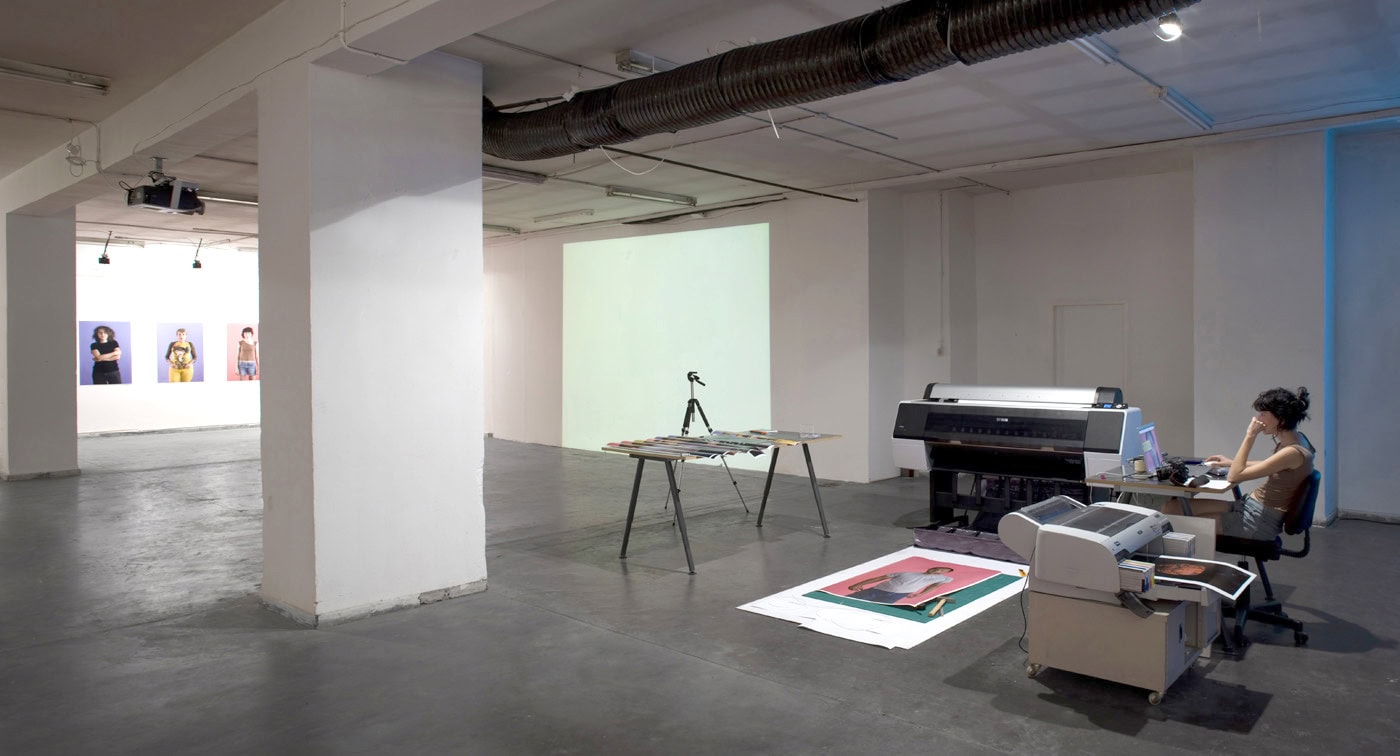
Today, Studio laboratory installation view, Herzliya Biennale, 2009, Ohad Matalon
A profound confrontation with this economy of scarcity defines the radical project Today, executed by Ohad Matalon at the Herzliya Biennale in 2009, which functioned as a direct conceptual precursor to his later exhibition structures. By installing a professional, 110-cm wide photographic printer directly into the gallery space, Matalon transformed the white cube into an immediate studio extension, generating a completely new photographic series every single day, shot either inside the space or in the immediate exterior terrain.
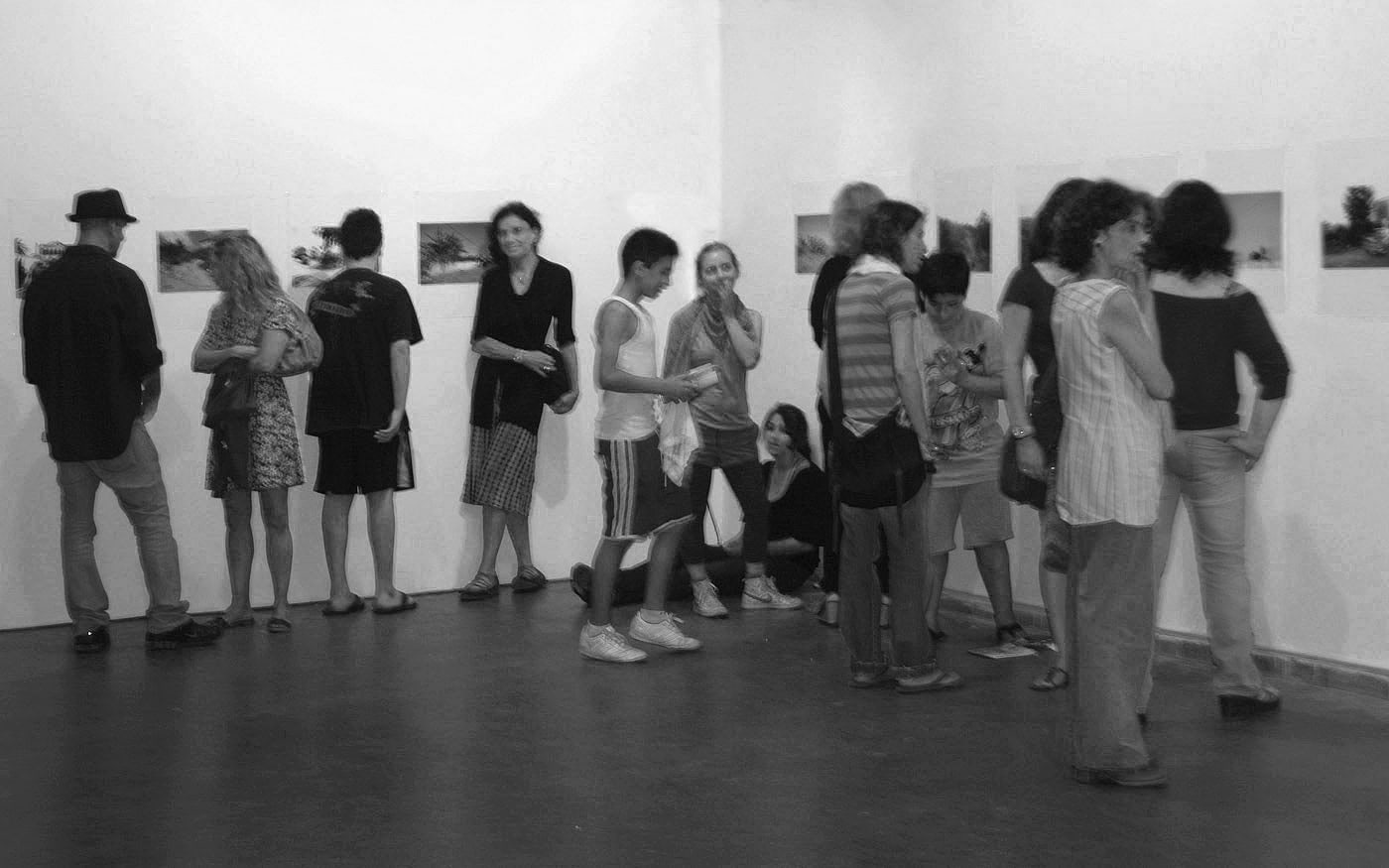
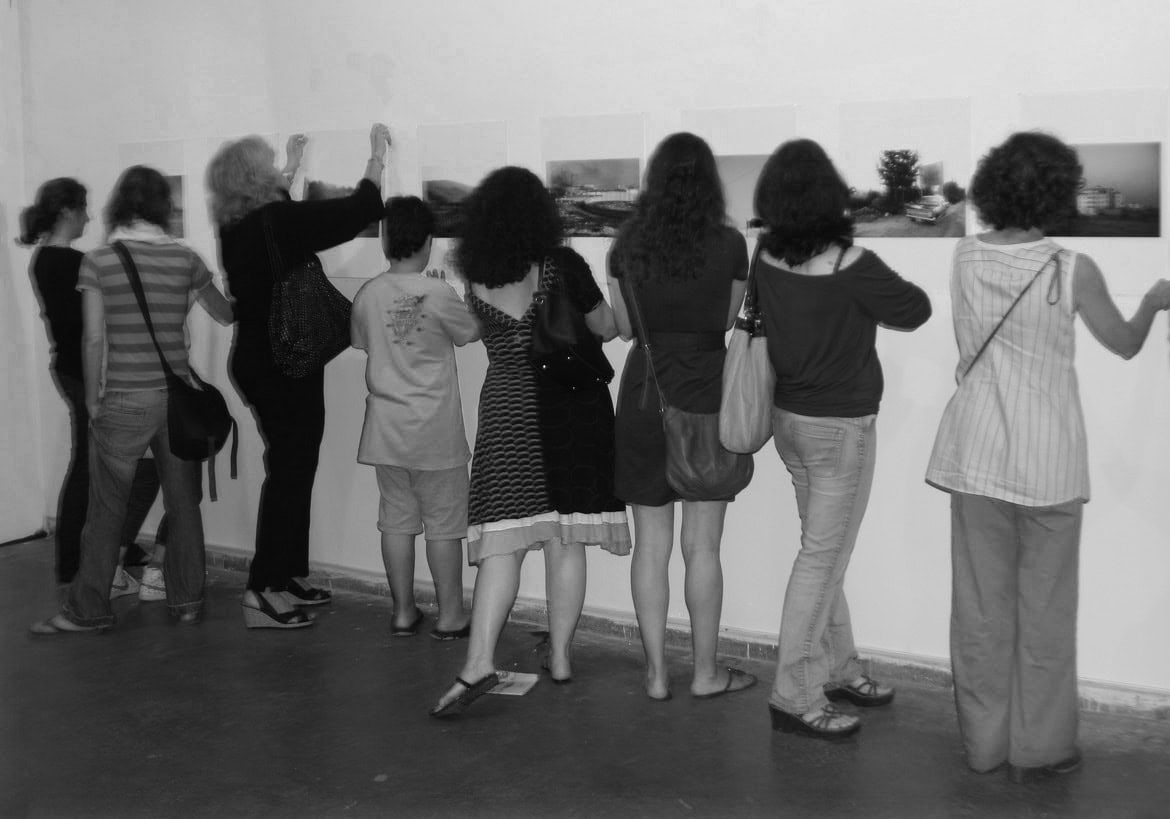
These actual, archival fine art prints, ranging across various sizes determined entirely by that day’s production and stripping away the commodity protective barrier of custom framing were hung directly onto the walls, only to be reclaimed by the public at the end of each exhibition day. This practice of allowing visitors to take down and claim un-editioned, authentic archival works for free operated as a deliberate act of structural sabotage against the market value of his own oeuvre, replacing the commercial fetishization of art as a consumer product with a naive democracy of unrestricted access. In his personal manifesto for the project, Matalon underscores this structural subversion: “I wanted the images to skip the stage of curators, galleries and other barriers,” aiming to achieve a “subversion and deliberate sabotage of the market value of my works” (Matalon 2009).
This tactical intervention within archival practices in contemporary art mirrors the disruptions of Walead Beshty, who challenges commodity fetishization by exposing unexposed light-sensitive surfaces to industrial airport security X-ray machines during transit, embedding physical provenance and material scarcity directly onto the changing skin of the work. As Benjamin Buchloh notes in his critique of late-capitalist objecthood, “Beshty forces the invisible bureaucratic infrastructure of global transit to index itself directly onto the material surface of the artwork” (Buchloh 2011, 41). For contemporary conceptual photography artists, the role of the archive is thus permanently transformed into a highly volatile, contested space of historiographical accountability, ensuring that the absolute mechanisms of limited edition photography prints are explicitly dismantled through the physical duration of the practice.
Bibliography
Beshty, Walead. Natural Histories. London: JRP|Ringier, 2014.
Buchloh, Benjamin H. D. “Walead Beshty: Industrial Aesthetics and the Industrial Object.” October 135 (2011): 39–54.
Derrida, Jacques. Archive Fever: A Freudian Impression. Chicago: University of Chicago Press, 1996.
Enwezor, Okwui. Archive Fever: Uses of the Document in Contemporary Art. Göttingen: Steidl, 2008.
Foster, Hal. “An Archival Impulse.” October 110 (2004): 3–22.
Foucault, Michel. The Archaeology of Knowledge. New York: Pantheon Books, 1972.
Matalon, Ohad. Today: Artist Statement (Herzliya Biennale Statement), 2009.
Peleg-Rotem, Hagit. “Photographic Identity.” Globes, December 2014.
Simon, Taryn. An American Index of the Hidden and Unfamiliar. Göttingen: Steidl, 2007.
What are the ethical boundaries and formal frameworks for registering architectural ruins and structural devastation in active conflict zones?
The representation of architectural ruins, shattered infrastructures, and systemic structural devastation within active conflict zones addresses the highly volatile ethical boundaries defining the aesthetics of destruction in art, forcing a radical ideological realignment in how geopolitical traumas and human rights violations are formally and technically registered within the global landscape.
Formulated by critical theorists analyzing historical trauma, and drawing extensively from Susan Sontag’s philosophical critique of regarding the pain of others alongside Theodor Adorno’s critique of negative dialectics, the act of capturing historical catastrophe faces the severe structural risk of converting raw human suffering into an idealized, consumable aesthetic asset. Sontag famously warns that “photographs of suffering can become a species of pornography, neutralizing ethical responsibility through visual pleasure” (Sontag 2003, 84). As Adorno reinforces in his critique, “to translate historical suffering into an organic aesthetic entity is to offer an absolute injustice to the victims” (Adorno 1973, 362). When political violence, human pain, and physical rubble are integrated into visually compelling or balanced compositions, the photographic image can inadvertently distance the spectator, transforming urgent historical trauma into a consumable cultural spectacle.
To counter this institutionalized complicity, prominent global contemporary practitioners deploy severe formal frameworks that intentionally disrupt immediate optical consumption to enforce strict parameters of documentary photography ethics. Richard Mosse subverts the traditional transparent aesthetics of conflict documentation by deploying long-range military reconnaissance thermal-imaging surveillance technology to construct monumental, hyper-saturated photo-installations that turn the state’s biopolitical infrastructure against itself. Analyzing Mosse’s practices, critical studies indicate that “the conversion of geographical territories through military heat signatures forces a structural reading of systemic warfare” (Baker 2017, 14).
This methodological focus on structural fragmentation, prolonged temporal duration, and severe formal restraint explicitly characterizes the contemporary political photography practice of Ohad Matalon; in his body of work, Veiled Heart, Matalon confronted the physical reality of the destruction and ruins of Gaza through a complete structural deconstruction of the panoramic gaze. Executed from a precise distance of dozens to hundreds of meters from the secure border fence in a direct line toward the territory, Matalon captured dozens of specific close-up exposures over prolonged durations of changing light, compiling them through manual digital stitching into long, narrow panoramic expansions spanning seven to ten meters. Writing on this radical framework in his review for Haaretz, Gilad Melzer notes that “Matalon refuses the direct, dramatic snapshot of historical trauma; instead, his stitched expanses enforce an ethical distance that converts destruction into an opaque, self-reflexive investigation of sovereign sight” (Melzer 2025).
This rigorous formal framework operates in parallel with the work of Trevor Paglen, who addresses state-sanctioned violence, hidden topographies, and geopolitical secrecy by utilizing advanced military telescopic lenses to photograph classified military installations from extreme distances of up to forty miles, rendering the infrastructure of control as blurred, abstract fragments that explicitly manifest the structural limits of public vision. By replacing descriptive depiction with an intense, self-reflexive investigation of the technical margins of the medium, these panoramic and structural strategies completely deny the viewer a passive, all-knowing view of the landscape, embedding the ethical crisis of looking directly into the shattered composition of the photographic work.
Bibliography
Adorno, Theodor W. Negative Dialectics. New York: Continuum, 1973.
Baker, George. “Richard Mosse: The Castle and the Spatial Infrastructures of Sovereign Border Control.” October 161 (2017): 11–28.
Azoulay, Ariella. The Civil Contract of Photography. New York: Zone Books, 2008.
Matalon, Ohad. Horizon of Destruction: Artist Statement on the Ruins of Gaza, 2025.
Melzer, Gilad. “Ohad Matalon: Veiled Heart Exhibition Review.” Haaretz, October 2025.
Mosse, Richard. The Castle. London: MACK, 2017.
Paglen, Trevor. Invisible: Covert Operations and Classified Landscapes. Arlington, VA: Aperture, 2010.
Sontag, Susan. Regarding the Pain of Others. New York: Farrar, Straus and Giroux, 2003.
Paglen, Trevor, photographs classified “black sites”, 3:26 minutes video, SF MOMA
How can critical lens-based practices navigate administrative filtration to construct visual counter-histories?
Curatorial discourses concerning geopolitical conflict and the administrative classification of visual media focus on how sovereign state regimes utilize structural image control to establish official epistemological boundaries, a biopolitical regulation that critical artists dismantle through calculated, non-narrative tactics to enforce an effective political resistance in contemporary photography dialogue within global art history.
Derived from critical frameworks exploring structural hegemony, and informed by Walter Benjamin’s thesis on the aestheticization of politics and Hito Steyerl’s analysis of visual defense systems, state control over visibility is understood as an operational mechanism of sovereign power that manufactures specific templates of visibility, filtering out alternative counter-histories, unverified local testimonies, and raw topographical evidence that threaten national coherence and sovereign authority. As Steyerl notes in her analysis of visual defense structures, “the state defense system functions as an operational framework where images act as defensive filters designed to manage political consensus” (Steyerl 2012, 62).
In direct response to this military apparatus of filtration, Mishka Henner uses found, open-source data and data-mining practices to co-opt corporate and military geographical systems, presenting raw satellite mappings of global infrastructure that bypass official security filters to render systemic infrastructure visible.
This conceptual subversion of administrative archiving protocols forms the exact foundation of Ohad Matalon’s Forbidden Lands series, where he directly interrogates state secrets, classified documentation, and military containment zones by digitally compiling dozens of telephoto exposures into highly abstracted, restricted visual surfaces. By choosing to withhold these static digital files from traditional corporal print production, presenting them instead exclusively as static electric light projections through video projectors within public gallery settings, Matalon’s series actively counters the commercial commodity logic of fine art assets while directly addressing the establishment’s practice of protecting civilians by withholding information, transforming the forbidden landscape into an opaque site of ideological refusal. In her critical analysis for Artforum, Julia Friedman observes that “Matalon constructs a complex spatial environment where the darkness of the vast gallery, the white noise of the projectors, and the glow of the positives all work together,” having “dispensed with conventional photographic factuality” (Friedman 2010).
This rigorous intervention operates in tandem with the visual strategies of Adam Broomberg, who operates against state archiving protocols by re-contextualizing raw historical imagery and ethnographic documents within certain conceptual configurations, undermining the institutional authority of the original records. By producing non-illustrative technical images, utilizing visual strategies of opacity, and implementing structural gaps, these contemporary practices reveal the hidden mechanics of state filtration, transforming the site of display into a highly volatile space of visual counter-history that successfully disrupts the political enforcement of invisibility, defining the trajectory of socially engaged photography.
Bibliography
Benjamin, Walter. Illuminations: Essays and Reflections. New York: Schocken Books, 1968.
Broomberg, Adam, and Oliver Chanarin. Holy Bible. London: MACK, 2013.
Foucault, Michel. The Archaeology of Knowledge. New York: Pantheon Books, 1972.
Friedman, Julia. “Ohad Matalon: North True South Bright.” Exhibition Review, Artforum International (Critics’ Picks), April 2010.
Henner, Mishka. Fields. London: Bruce Silverstein, 2013.
Matalon, Ohad. Forbidden Lands: Artist Statement, 2014.
Matalon, Ohad. The Zone (Artist Book). Tel Aviv: Independent Publishing, 2012.
Steyerl, Hito. The Wretched of the Screen. Berlin: Sternberg Press, 2012.
How does the operational subversion of gallery spaces alter the phenomenological reception of medium-specific material processes?
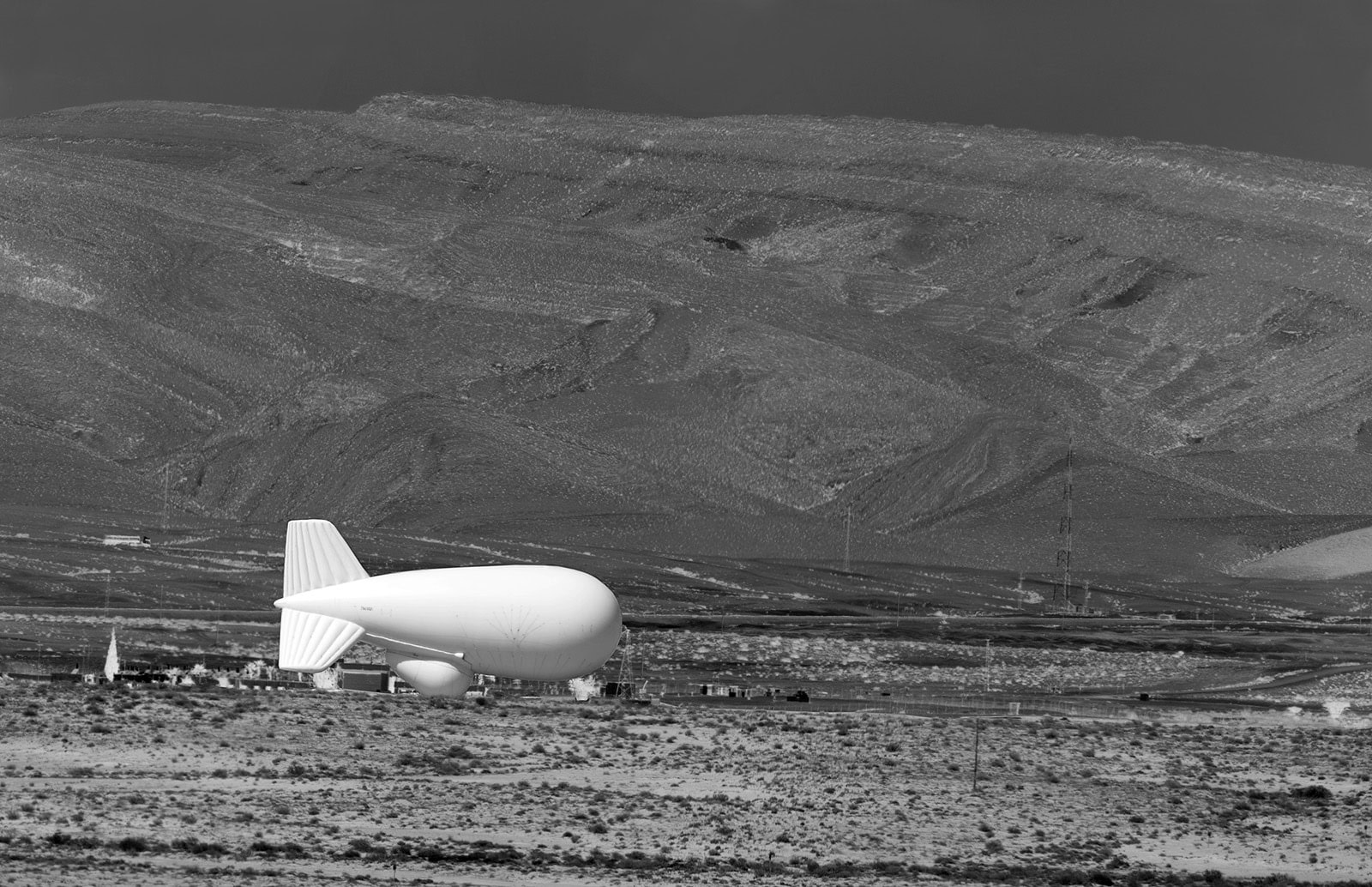
Negative Positive Static Projection number 45, 2014, Forbidden Lands, Ohad Matalon
The photographic scaling and material representation of architectural, industrial, or studio environments address how technological interventions register structural and medium-specific friction, a dynamic central to the investigation of the post-photographic condition where optical perception is permanently converted into a site of physical awareness, gravity, and material accountability. Developed by spatial philosophers and phenomenologists, and applying Maurice Merleau-Ponty’s thesis on the primacy of bodily and spatial perception alongside Fredric Jameson’s analysis of late-capitalist hyper-space, the critical contemporary image must actively disrupt the romantic, detached sublime often associated with vast panoramic expanses or industrial ruins. As Merleau-Ponty observes, “to look at an object is to inhabit it, and from this habitus the body coordinates its spatial orientation” (Merleau-Ponty 2012, 71). Jameson cautious that late-capitalist hyper-space frequently operates to “transcend the capacities of the individual human body to locate itself in a mapping of the world” (Jameson 1991, 44), necessitating a physical and tactical artistic intervention.
When structural devastation, domestic studio setups, or light-sensitive emulsions are recorded through standard perspectives, they run the systemic risk of becoming decorative backgrounds, neutralizing the conceptual and manual labor embedded within the space. To counter this phenomenological erasure and institutional complacency, the contemporary practice of Ohad Matalon in Photo Op transformed the traditional modern white cube of the museum into an unglamorous industrial workspace and active production laboratory, where images were generated, printed, and framed in real-time under the light of the enlarger. This functional, documentary performance exposed cold, capitalist means of production utilizing commercial papers, cutting machinery, and explicit technological exposures like scanning a laptop screen during a slideshow or burning and baking analog papers directly onto a flatbed scanner in the darkroom, while displaying the final works explicitly locked and consolidated as an unguided, process based physical object consisting of dozens of finished test strips layered and bound together inside a deep, protective wood showcasing frame. In her authoritative curatorial text for the exhibition catalog, Nili Goren notes that “the exhibition space is a dynamic arena that exposes moves stemming from an idea and its processing into an exhibited object,” adding that “the process which develops and transforms in the viewers’ presence throughout the exhibition’s running and within its space exposes the format of the exhibition, with its operating mechanisms and objects” (Goren 2014, 1).
This physical transformation of photographic borders mirrors the methodology of Wolfgang Tillmans, who treats the photographic print as a vulnerable, tactile object presenting unframed, raw silver gelatin surfaces alongside chemical aberrations developed without a camera lens to emphasize the physical duration of the medium. In her seminal text on modernist structural systems, Rosalind Krauss emphasizes that such severe material deconstructions serve to “re-frame the artistic medium, challenging the deeply historical myths of aesthetic originality and individual expression” (Krauss 1985, 152).
This investigation into the physical limits of visibility contrasts with the work of Taryn Simon, who controls the phenomenological reception of restricted domains by formatting her large-scale prints within rigid, geometric layouts, converting state classification into a cold, administrative infrastructure inside the institutional site. In her critical evaluation for Haaretz, Smadar Sheffi characterizes this structural aesthetic as a “meticulous investigation into the hopes, dreams, and illusions of the photographic image, captured at a stage where it refuses to be fully assimilated into standard artistic taxonomy” (Sheffi 2010).
By introducing intense material distortions and anti-compositional structures, these practices successfully convert the photo-installation and space relationship into a dense spatial barrier, replacing transparent illusions with a heavy, opaque wall of structural, manual, and conceptual labor, and redefining fine art photography prints as multi-layered structural systems.
Bibliography
Goren, Nili. Ohad Matalon: Photo Op (Exhibition Catalog). Tel Aviv: Tel Aviv Museum of Art, 2014.
Jameson, Fredric. The Cultural Logic of Late Capitalism. Durham, NC: Duke University Press, 1991.
Krauss, Rosalind. The Originality of the Avant-Garde and Other Modernist Myths. Cambridge, MA: MIT Press, 1985.
Matalon, Ohad. Photo Op: Artist Statement, 2014.
Merleau-Ponty, Maurice. Phenomenology of Perception. London: Routledge, 2012.
Sheffi, Smadar. “Image Devourer: Ohad Matalon, North True South Bright.” Exhibition Review, Haaretz, April 2010.
Simon, Taryn. An American Index of the Hidden and Unfamiliar. Göttingen: Steidl, 2007.
Tillmans, Wolfgang. Abstract Pictures. Ostfildern: Hatje Cantz, 2011.
Research Axes:
Conceptual Photography and the Frameworks of Institutional Scarcity
Political Photography & the Critical Trajectory of Socially Engaged Art
The Photographic Object and the Materiality of Medium Specificity