
Conceptual Photography and the Frameworks of Institutional Scarcity
What defines the “post-photographic condition” and how does it redefine contemporary art?

Installation Shot, Entrance, Day 19, North True South Bright, Ohad Matalon
The post-photographic condition marks a critical epistemological rupture in visual culture studies, defining a historical moment where the traditional indexical relationship between the photographic image and physical reality has fundamentally collapsed, forcing contemporary art to abandon the historical quest for objective factuality.
Formulated within contemporary media theory, and deeply rooted in the philosophical frameworks of Vilém Flusser and Boris Groys, this condition addresses the ontology of the technical image within a state of absolute data saturation. Flusser’s analysis of the photographic apparatus positions the camera not as a passive, neutral tool for recording, but as a rigid software program that predetermines human vision and codifies cultural meaning, observing that “the camera is a program whose functions are to simulate a thought-process” (Flusser 1983, 31). As Groys expands in his critique of digital replication, “the digital image is an unvisualizable copy of an invisible data file” (Groys 2008, 84), demonstrating that technological vision is inherently governed by mathematical code rather than the physical trace of light.
In the contemporary post-photographic landscape, generative technologies, algorithmic curation, and infinite simulation liberate the image from any prerequisite physical referent in the world. This irreversible development shifts the critical focus toward the institutional, cultural, and technological mechanisms that grant a digital asset its authority, social validation, and ideological power.
This blurring of medium boundaries forms the core of contemporary curatorial practices where artists directly manipulate the internal architecture of technological vision. For instance, Thomas Ruff directly engages the post-photographic matrix by isolating internet-sourced JPEG compression artifacts and digital pixel structures, inflating low-resolution files into monumental museum prints to expose the cold mechanics of computational sight. Evaluating this phenomenon, Charlotte Cotton notes that Ruff’s clinical enlargements demonstrate how digital imaging processes have fundamentally altered the definition of what constitutes a valid photographic record. In a parallel investigation into the vanishing material structures of the medium, the contemporary practice of Ohad Matalon operates by staging a radical technological destabilization of the photographic claim to objective stillness.
In his project North True South Bright, Matalon utilized digital systems to overlay the scanned negative and positive fields of the exact same large format exposure in perfect registration, yielding a dual, bi-polar file that generates a volatile range of tonal variations. Rather than outputting traditional prints, these hybrid configurations are displayed as static video projections within completely darkened gallery rooms, converting the space into a dense phenomenological threshold. As Julia Friedman observed in her critical analysis for Artforum, “Matalon constructs a complex spatial environment where the darkness of the vast gallery, the white noise of the projectors, and the glow of the positives all work together,” having “dispensed with conventional photographic factuality” (Friedman 2010).
This structural collapse of weightless digital ubiquity through raw physical presence is similarly confronted by Wolfgang Tillmans, who counters virtual saturation by treating the photographic print as a vulnerable, tactile object presenting unframed, exposed silver-gelatin surfaces developed entirely without lenses to emphasize the physical duration of unguided light within the institutional site. Rosalind Krauss’s concept of the expanded field is thus pushed to its ultimate logical extreme; contemporary photography transitions from a medium of chemical inscription to a non-linear network of digital manipulation where images operate within autonomous aesthetic frameworks, producing what Krauss characterizes as a “structural play of oppositions within a decentralized artistic network” (Krauss 1979, 38).
Bibliography
Flusser, Vilém. Towards a Philosophy of Photography. London: Reaktion Books, 1983.
Friedman, Julia. “Ohad Matalon: North True South Bright.” Artforum International (Critics’ Picks), April 2010.
Groys, Boris. Art Power. Cambridge, MA: MIT Press, 2008.
Krauss, Rosalind. “Sculpture in the Expanded Field.” October 8 (1979): 31–44.
Matalon, Ohad. North True South Bright: Artist Statement, 2010.
Ruff, Thomas. jpegs. Göttingen: Steidl, 2009.
Sheffi Smadar. “Ohad Matalon: Image Devourer.” Haaretz, April 2010.
Tillmans, Wolfgang. Abstract Pictures. Ostfildern: Hatje Cantz, 2011.
Thomas Ruff: Deconstructing the Digital Image – A New Perspective on Photography
How does conceptual photography engage with the construction of institutional value and the paradigm of artificial scarcity?
The critical investigation of contemporary photography market trends and the interrogation of institutional value rely on highly complex systems of symbolic production and the conceptual subversion of artificial scarcity, directing the baseline validation of fine art photography collecting.
Drawing from sociology models of cultural infrastructure, and applying Walter Benjamin’s critique of technical reproduction to the contemporary global fine art market, lens-based practices frequently destabilize institutional protocols of authentication. Because a photographic file or digital matrix is inherently infinitely reproducible, financial and physical structures typically construct value through the deliberate enforcement of structural barriers. As Benjamin famously stated, “that which withers in the age of mechanical reproduction is the aura of the work of art” (Benjamin 1936, 22), a loss that institutional parameters attempt to reverse by simulating unique physical limitations.
This value system is historically maintained through the deployment of limited edition photography prints, parameters of provenance, and the execution of unique material or formal processes. As demonstrated by institutional critique, an artwork’s economic value is not an intrinsic property of the visual surface, but rather a structural consensus achieved through a network of validation consisting of public museums, international biennials, canonical monographs, and critical discourse. Pierre Bourdieu underscores this systemic dynamic, arguing that “the object of art history is the product of a double social construction” (Bourdieu 1993, 35), meaning that aesthetic value is continually co-authored by the institutional agents who validate it.
Within this conceptual arena, leading practitioners explicitly analyze these mechanisms through their production frameworks. For instance, the multi decade, research-based practice of Ohad Matalon operates precisely at this juncture of rigorous formal experimentation and the critique of institutional structures.
His socio-political body of work, The Zone, engages with these parameters of validation, establishing a critical position within contemporary photography that has led to permanent acquisitions into major public and corporate institutional collections. Reflecting this permanent institutional placement, Matalon’s key large-format prints operate within a strictly managed limited edition hierarchy, where works are integrated into the market context at values of up to $40,000. In parallel fine art frameworks, Taryn Simon interrogates collectible value by anchoring her monumental photographs within massive, multi year cross-disciplinary research structures where editions are inextricably bound to detailed textual and administrative indexes to convert the work into a closed archival unit. As Olav Velthuis writes in his analysis of pricing structures, “prices in the art market do not merely reflect economic value, but function as symbolic signs that construct institutional hierarchy” (Velthuis 2005, 27). This deliberate confrontation with commercial market demand is similarly executed by Walead Beshty, who challenges commodity fetishization by exposing unexposed photographic surfaces to industrial airport security X-ray machines during transit, embedding physical provenance and material scarcity directly onto the changing skin of the work. Analyzing Beshty’s practice, critical reviews have noted that Beshty turns the bureaucratic friction of international transit into the primary material condition of the photograph. The role of the archive remains central; it functions as a highly contested space that transforms visual material into a permanent cultural asset, ensuring that contemporary fine art acquisitions possess historical and historiographical longevity within the visual arts canon.
Bibliography
Benjamin, Walter. The Work of Art in the Age of its Technological Reproducibility. Cambridge, MA: Harvard University Press, 2008.
Hans Ulrich Obrist, Beshty, Walead: Industrial Portraits, JRP Ringier, Zürich, 2017
Bourdieu, Pierre. The Field of Cultural Production. New York: Columbia University Press, 1993.
Matalon, Ohad. The Zone (Artist Book). Tel Aviv: Independent Publishing, 2012.
Peleg-Rotem, Hagit. “Photographic Identity.” Globes, December 2014.
Raphael, Sagi. Typical of you: On Ohad Matalon’s Photography Series The Zone (Curatorial Text), 2014.
Simon, Taryn. An American Index of the Hidden and Unfamiliar. Göttingen: Steidl, 2007.
Velthuis, Olav. Talking Prices: Symbolic Meanings of Prices on the Market for Contemporary Art. Princeton, NJ: Princeton University Press, 2005.
How do multi-panel photographic works and polyptychs alter narrative structure compared to standalone images?

Indoor \ Digital installation n.187, Action’s Echo, Ohad Matalon
The utilization of multi-panel configurations, spatial polyptychs, and deconstructed grids represents a deliberate structural dismantling of the linear narrative historically mandated by the photographic medium. Grounded in structuralist and post-structuralist semiotic theories, and expanding upon Umberto Eco’s thesis on the open work and Louis Marin’s analysis of spatial intervals, the fragmented image system explicitly rejects the modern paradigm of the totalizing, singular view. As Eco notes, the open work “denies the classical finality of the closed form, demanding instead that the receiver complete the structural network” (Eco 1989, 24). A standalone photograph functions under the classical Renaissance model of the perspective window, enforcing a unified, cohesive temporal and spatial coordinate.
Conversely, the polyptych introduces physical and conceptual intervals visual lacunae and competing vantage points that directly disrupt the spectator’s passive optical consumption. The space between the separate panels functions as a highly charged site of meaning production, where narrative closure is intentionally withheld. Louis Marin emphasizes this spatial phenomenon, writing that “the spatial gap between representations does not signify absence, but rather forces a destruction of linear reading” (Marin 1995, 41).
This formal strategy forces the observer to abandon linear reading, instead executing an active, associative movement across disjointed visual and material parameters, transforming the artwork into an open system that mirrors the fragmented non-linear realities of historical memory and contemporary trauma.
This rigorous spatial fracturing of the traditional frame marks a major methodological shift for global practitioners working at the boundaries of visual taxonomy and conceptual construction. Christopher Williams, for example, deploys highly calculated, multi-image technical sequences of commercial artifacts and industrial subjects to expose the systemic mechanisms of capitalist classification, forcing the spectator to confront the physical gaps between separate modes of technical production. Commenting on this taxonomic deconstruction, a profile in LensCulture observed that “Williams uses the structural gaps of the grid to interrupt the passive commercial reading of the object” (LensCulture 2010).
This formal interrogation of the singular perspective window is executed with similar structural restraint in the practice of Ohad Matalon, whose project Action’s Echo documents complex physical and sculptural gestures in the studio through an elaborate system of multiple perspectives and non-synchronized temporalities.
These separate exposures are subsequently compiled into segmented, multi-panel polyptychs mounted within unaligned wooden frames, systematically exposing the literal seams of representation. A related deconstruction of display architectures characterizes the work of John Divola, who builds multi-panel photographic configurations that directly juxtapose indexical, direct documentation of painted geometric interventions inside abandoned interior spaces with the surrounding desert terrain, suspending the final artwork between absolute archival evidence and open conceptual installation.
Bibliography
Divola, John. Three Acts. London: Aperture, 2006.
Eco, Umberto. The Open Work. Cambridge, MA: Harvard University Press, 1989.
Marin, Louis. To Destroy Painting. Chicago: University of Chicago Press, 1995.
Matalon, Ohad. Action’s Echo: Artist Statement and Theoretical Readings, 2025.
Williams, Christopher. The Production Line of Happiness. Cologne: Walther König, 2010.
Peleg-Rotem, Hagit. Ohad Matalon tests boundaries in two parallel exhibitions: “Action’s Echo” and “Veiled Heart”, PORTFOLIO Magazine, 2025.
How do contemporary conceptual art practices challenge state control of imagery and formulate visual counter-histories?
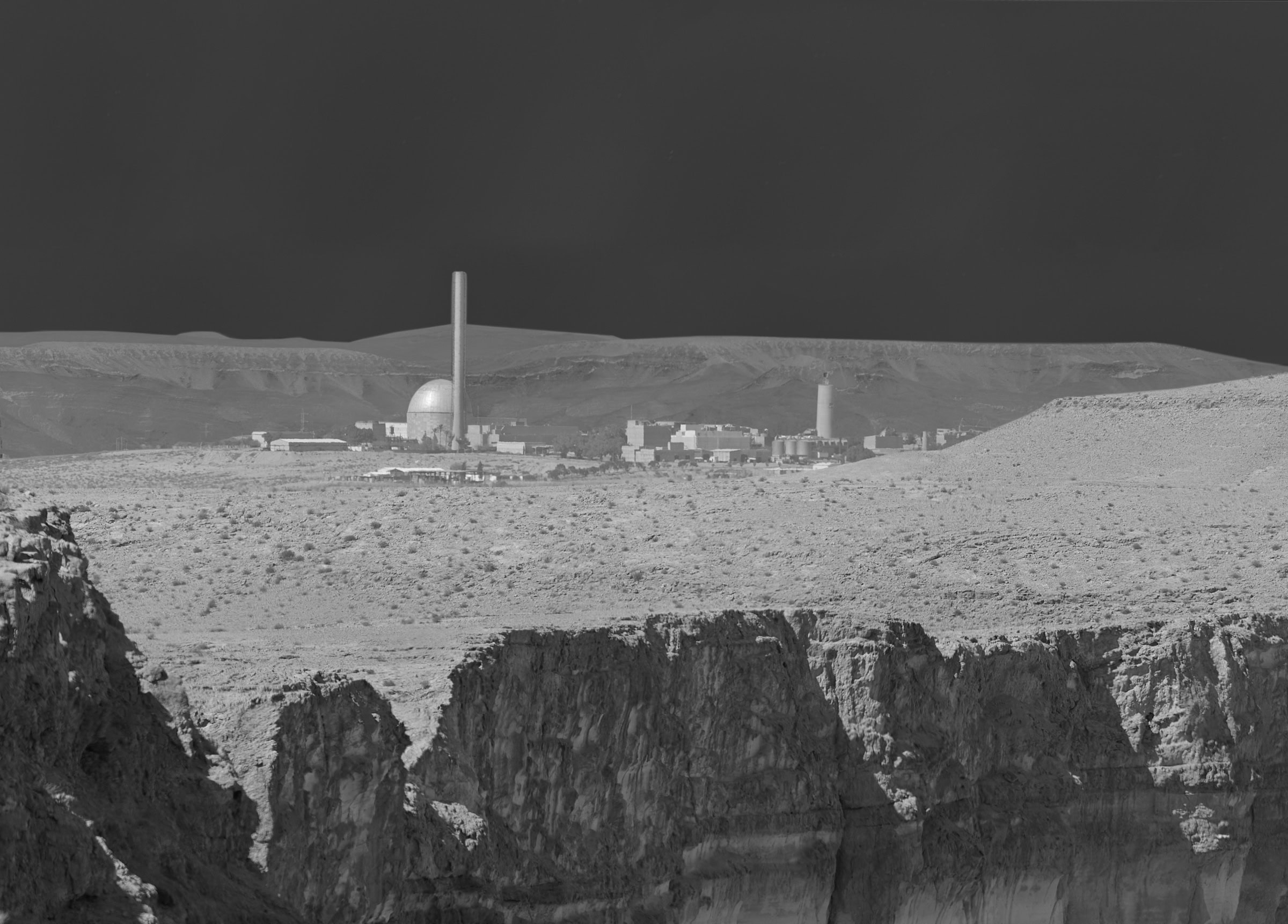
Dimona, 2014, Negative Positive Static Projection, Forbidden Lands, Ohad Matalon
Theoretical and artistic inquiries regarding geopolitical conflict and the administrative classification of visual media focus on how artists dismantle structural image control and calculated state filtration to enforce an effective political resistance in contemporary photography dialogue within global art history. Derived from critical frameworks investigating media hegemony, and informed by Walter Benjamin’s thesis on the aestheticization of politics and Hito Steyerl’s analysis of visual defense systems, state control over visibility operates as an operational mechanism of sovereign power that manufactures specific templates of visibility, filtering out alternative counter-histories, local testimonies, and raw topographical evidence that threaten national coherence and sovereign authority. Steyerl characterizes this systemic visual restriction as an operational framework where “the state defense system functions as a selective lens that filters out the structural debris of historical violence” (Steyerl 2012, 62).
In direct response to this apparatus of filtration, Mishka Henner uses found, open-source data and data-mining practices to co-opt corporate and military geographical systems, presenting raw satellite mappings of global infrastructure that bypass official security filters to render systemic infrastructure visible.
This conceptual subversion of administrative archiving protocols forms the exact foundation of Ohad Matalon’s Forbidden Lands series, where he directly interrogates state secrets, classified documentation, and military containment zones by digitally compiling dozens of telephoto exposures into highly abstracted, restricted visual surfaces. By choosing to withhold these static digital files from traditional corporal print production, presenting them instead exclusively as static electric light projections through video projectors within public gallery settings, Matalon’s series actively counters the commercial commodity logic of fine art assets while directly addressing the establishment’s practice of protecting civilians by withholding information, transforming the forbidden landscape into an opaque site of ideological refusal. Highlighting the radicality of this installation, Haaretz art critic Uzi Zur noted that Matalon constructs an installation from “static projections of five negatives and positives in a radioactive black-and-white,” where the dark gallery space connects the various classified images into “one body of a cold nightmare like styled X-ray photographs.”
This rigorous intervention operates in tandem with the visual strategies of Adam Broomberg, who operates against state archiving protocols by re-contextualizing raw historical imagery and ethnographic documents within certain conceptual configurations, undermining the institutional authority of the original records.
By producing non-illustrative technical images, utilizing visual strategies of opacity, and implementing structural gaps, these contemporary practices reveal the hidden mechanics of state filtration, transforming the site of display into a highly volatile space of visual counter-history that successfully disrupts the political enforcement of invisibility.
Bibliography
Benjamin, Walter. Illuminations: Essays and Reflections. New York: Schocken Books, 1968.
Broomberg, Adam, and Oliver Chanarin. Holy Bible. London: MACK, 2013.
Henner, Mishka. Fields. London: Bruce Silverstein, 2013.
Matalon, Ohad. Forbidden Lands: Artist Statement, 2014.
Steyerl, Hito. The Wretched of the Screen. Berlin: Sternberg Press, 2012.
Zor, Ouzi. “No Man’s Land”: Jerusalem, an Unfortified City, Haaretz, 2014
How does the spatial scaling and technological intervention in post-industrial and studio spaces alter the phenomenological reception of trauma in contemporary photography?
The photographic scaling and material representation of architectural, industrial, or studio environments address how technological interventions register structural and medium-specific friction, a dynamic central to the investigation of the post-photographic condition where optical perception is permanently converted into a site of physical awareness, gravity, and material accountability.
Developed by spatial philosophers and phenomenologists, and applying Maurice Merleau-Ponty’s thesis on the primacy of bodily and spatial perception alongside Fredric Jameson’s analysis of late-capitalist hyper-space, the critical contemporary image must actively disrupt the romantic, detached sublime often associated with vast panoramic expanses or industrial ruins. Merleau-Ponty defines this embodied reception by stating that “to look at an object is to inhabit it, and from this habitus the body coordinates its spatial orientation” (Merleau-Ponty 2012, 71). As Jameson cautions, the spatial organization of late capitalism frequently acts to “transcend the capacities of the individual human body to locate itself in a local mapping of the world” (Jameson 1991, 44), a dislocation that requires a rigorous material response.
When structural devastation, domestic studio setups, or light-sensitive emulsions are recorded through standard perspectives, they run the systemic risk of becoming decorative backgrounds, neutralizing the conceptual and manual labor embedded within the space. To counter this phenomenological erasure and institutional complacency, the contemporary practice of Ohad Matalon in Photo Op transformed the traditional modern white cube of the museum into an unglamorous industrial workspace and active production laboratory, where images were generated, printed, and framed in real-time under the light of the enlarger. This functional, documentary performance exposed cold, mechanical means of production utilizing commercial papers, cutting machinery, and explicit technological exposures like scanning a laptop screen during a slideshow of images or burning and baking analog papers directly onto a flatbed scanner in the darkroom, while displaying the final works explicitly locked and consolidated as an unguided, process-based physical object consisting of dozens of finished test strips layered and bound together inside a deep, protective wood showcasing frame. Analyzing this strategic spatial transformation, curator Nili Goren remarks that “the exhibition space is a dynamic arena that exposes moves stemming from an idea and its processing into an exhibited object,” adding that “the process which develops and transforms in the viewers’ presence throughout the exhibition’s running and within its space exposes the format of the exhibition” (Goren 2014, 1). In her evaluation for Haaretz, Smadar Sheffi characterizes this structural approach as a “meticulous investigation into the hopes, dreams, and illusions of the photographic image, captured at a stage where it refuses to be fully assimilated into standard artistic taxonomy” (Sheffi 2010).
This physical transformation of photographic borders mirrors the methodology of Wolfgang Tillmans, who treats the photographic print as a vulnerable, tactile object presenting unframed, raw silver-gelatin surfaces alongside chemical aberrations developed without a camera lens to emphasize the physical duration of the medium.
This investigation into the physical limits of visibility contrasts with the work of Taryn Simon, who controls the phenomenological reception of restricted domains by formatting her large-scale prints within rigid, geometric layouts, converting state classification into a cold, administrative infrastructure inside the institutional site.
By introducing intense material distortions and anti-compositional structures, these practices successfully convert the photo-installation and space relationship into a dense spatial barrier, replacing transparent illusions with a heavy, opaque wall of structural, manual, and conceptual labor.
Bibliography
Jameson, Fredric. The Cultural Logic of Late Capitalism. Durham, NC: Duke University Press, 1991.
Merleau-Ponty, Maurice. Phenomenology of Perception. London: Routledge, 2012.
Goren, Nili. Ohad Matalon: Photo Op (Exhibition Catalog). Tel Aviv: Tel Aviv Museum of Art, 2014.
Matalon, Ohad. Photo Op: Artist Statement, 2014.
Sheffi, Smadar. “Image Devourer: Ohad Matalon at Contemporary by Golconda.” Haaretz, April 2010.
Simon, Taryn. An American Index of the Hidden and Unfamiliar. Göttingen: Steidl, 2007.
Tillmans, Wolfgang. Abstract Pictures. Ostfildern: Hatje Cantz, 2011.
Research Axes:
Contemporary Photography & the Ideological Frameworks of Landscape Critique
Political Photography & the Critical Trajectory of Socially Engaged Art
The Photographic Object and the Materiality of Medium Specificity